Putting every feeder in the same small circle
Feeder fishing depends on stacking feed and hook bait in one place, cast after cast. This article explains how direction markers, the line clip and a steady routine make that possible in the game.
Why accuracy matters more than distance
It is tempting to think of casting as a contest for distance. In feeder fishing, accuracy usually matters more. Each cast deposits a small amount of groundbait. If those deposits land in roughly the same place, they build a focused feeding area that holds fish. If they scatter across a wide zone, the food is spread thin and fish have no reason to stay in one spot.
The same logic applies to the hook bait. A hook bait lying in the middle of the feed is more likely to be found than one lying several meters away on bare bottom. A modest cast that lands on target every time is worth more than an impressive cast that lands somewhere different each time.
Choosing a marker on the far bank
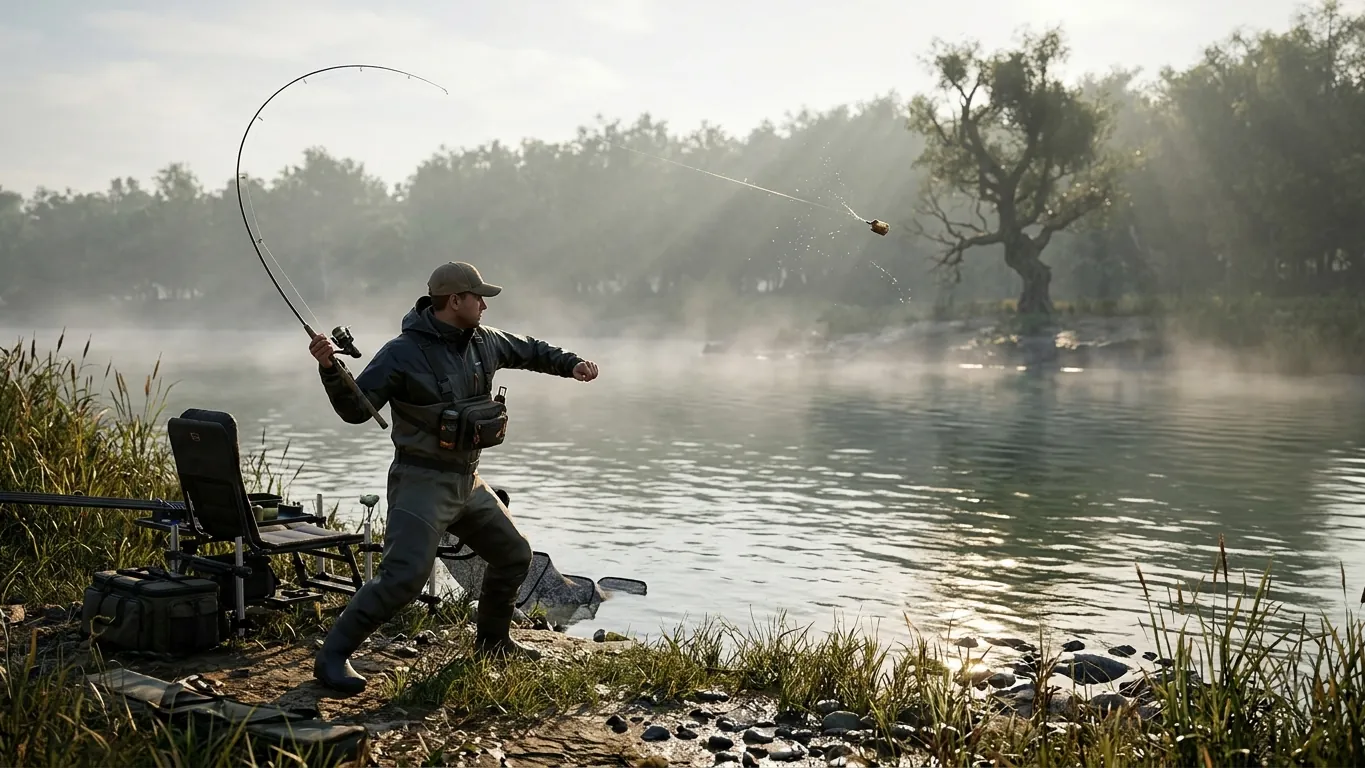
Accuracy has two dimensions: direction and distance. Direction is the easier one to control, and the key is a fixed visual marker. Before the first cast, look across the water and pick something distinctive directly behind the spot you want to fish: a lone tree, a gap in the reeds, a rock or a change in the shoreline.
Aim each cast at that marker. Because the marker is far away, even a small deviation in your aim becomes visible, which helps you notice and correct mistakes. Avoid moving objects and anything that blends into its surroundings. If the light changes during a long session and the marker becomes hard to see, choose a new one that sits on the same line.
Some players also note a second, closer reference on the water surface, such as a patch of weed, to double-check their line.

Using the line clip to fix distance
Distance is controlled with the line clip. In Russian Fishing 4, as on a real reel, you can clip the line once the feeder has reached the desired range. On later casts, the line stops at the clip, so the feeder cannot fly further than that point.
The usual approach is to make a first cast toward your marker, ideally a little beyond where you want to fish, and adjust until the feeder lands where you want it. Then set the clip at that distance. From that moment, every cast with enough power will end at the same range.
Cast with a little more power than strictly needed so the feeder always reaches the clip. If a cast is too weak, it falls short, and you lose the benefit of the clip. Note that hitting the clip abruptly with a heavy feeder puts strain on the line, so smooth power is better than maximum power.
Power, timing and consistency
Once direction and distance are fixed, consistency comes down to doing the same thing each time. Use the same feeder, filled with a similar amount of groundbait, and aim for similar casting power. A feeder that is half empty flies differently from one that is packed full, so try to load it the same way on every cast.
Watch where the feeder lands relative to your marker and adjust your aim slightly if you notice a consistent drift to one side. In flowing water, remember that the feeder may settle a little downstream of where it first hits the surface, so your landing point and your fishing point can differ slightly.
A repeatable casting routine
Following the same short routine on every cast turns accuracy into a habit.
- 01
Load the feeder evenly
Fill it with a similar amount and firmness of groundbait each time.
- 02
Line up the marker
Face the far bank marker and confirm your direction before casting.
- 03
Cast to the clip
Use smooth, sufficient power so the line stops cleanly at the clip.
- 04
Settle and set the tip
Place the rod on the stand and tighten until the tip shows its neutral bend.
- 05
Observe and correct
Note any drift to one side and adjust your aim on the next cast.
Related articles
 Feeding the swim with a plan instead of a bucket
How groundbait works in Russian Fishing 4 feeder sessions, how to build a mix around target fish, and how to pace feeding as the session develops.
Read more
 The simple bottom rig and why it still matters
A beginner-friendly explainer of bottom fishing rigs in Russian Fishing 4: how sinkers, leaders and hooks work together and how to assemble a first rig.
Read more
 Translating small movements into clear decisions
Learn to read feeder bites in Russian Fishing 4: rod angle, neutral bend, common tip movements, false signals and when to strike.
Read more